
Applied Mathematics Students Once Again Participate in the "Data Science in Sustainable Finance and Economics" Summer School at HTW Berlin
September 21, 2026 at 12:00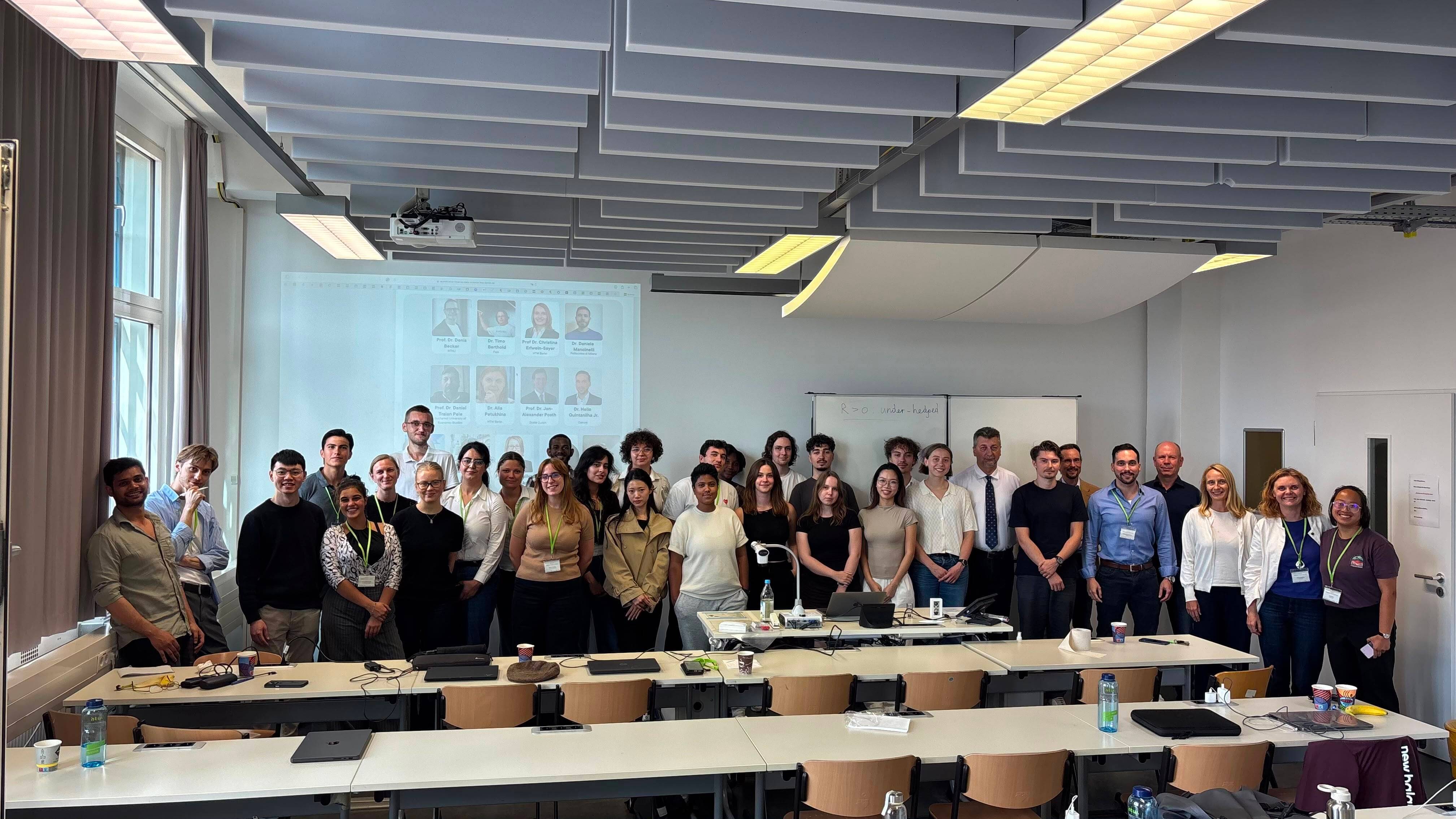
At the end of summer, students from the Applied Mathematics Department once again took part in the international summer school "Data Science in Sustainable Finance and Economics," hosted by the Hochschule für Technik und Wirtschaft Berlin (HTW Berlin).
This year, our department was represented by fourth-year undergraduate students Sofiia Buriak and Tamara Podpala, alongside third-year undergraduate student Paviel Ulanovskyi. The trip and participation of the Ukrainian students were made possible through the support of the DAAD Ostpartnerschaften programme.
The school was held in a hybrid format (Blended Intensive Programme): an online component ran from 24 to 28 August, followed by an in-person session on the HTW Berlin campus from 31 August to 4 September. The curriculum featured two practical tracks: "Portfolio Selection with ESG Constraints" and "Power Markets – Trading and Hedging a Retail Electricity Portfolio." All students from our department chose the first track, working on solutions to an industry-grade problem provided by FICO. To tackle these complex optimisation problems, participants were granted access to dedicated licences for the professional optimisation suite, FICO Xpress.
A key highlight of the event was immersion in a diverse international environment. Our students collaborated in cross-border teams, bridging distinct academic cultures and specialisations: the rigorous mathematical foundation and data analysis expertise of our applied mathematicians were complemented by teammates' in-depth domain knowledge in economics, international finance, and quantitative finance. This collaborative problem-solving approach fostered a comprehensive view of financial challenges—moving beyond abstract mathematical formulations to reflect real-world business constraints.
The core challenge of the track was formulating an investment portfolio optimisation model constrained by stringent Environmental, Social, and Governance (ESG) criteria. Sofiia Buriak shared her reflections on tackling the task and its underlying mathematical challenges:
"We transformed a decade of raw price time series into an actual portfolio of real-world companies—analysing which assets exhibited co-movement and failed to hedge one another, how ESG mandates necessitate balancing a high-yield company with poor ratings against a more modest, compliant enterprise, and identifying the exact inflection point where taking on an additional unit of risk is no longer compensated by returns.
Most of our time was spent on data preparation rather than the optimisation itself. Ten years of asset prices across eight currencies, missing values, and misaligned exchange calendars caused the sample covariance matrix used for risk estimation to lose positive semi-definiteness. To resolve this, we substituted it with a factor model, which ensures mathematical consistency while preserving empirical correlations across assets."
The other students shared a similar experience: engaging with uncurated time series, multi-currency datasets, industry-standard optimisation frameworks, and authentic problems posed by FICO reinforced that modern applied mathematics is about uncovering structure beneath noisy data and developing robust solutions where standard off-the-shelf methods fail.
We congratulate Sofiia, Tamara, and Paviel on the successful completion of the Summer School! We thank them for representing the department on the international stage and wish them continued academic achievement, engaging interdisciplinary endeavours, and further professional success.